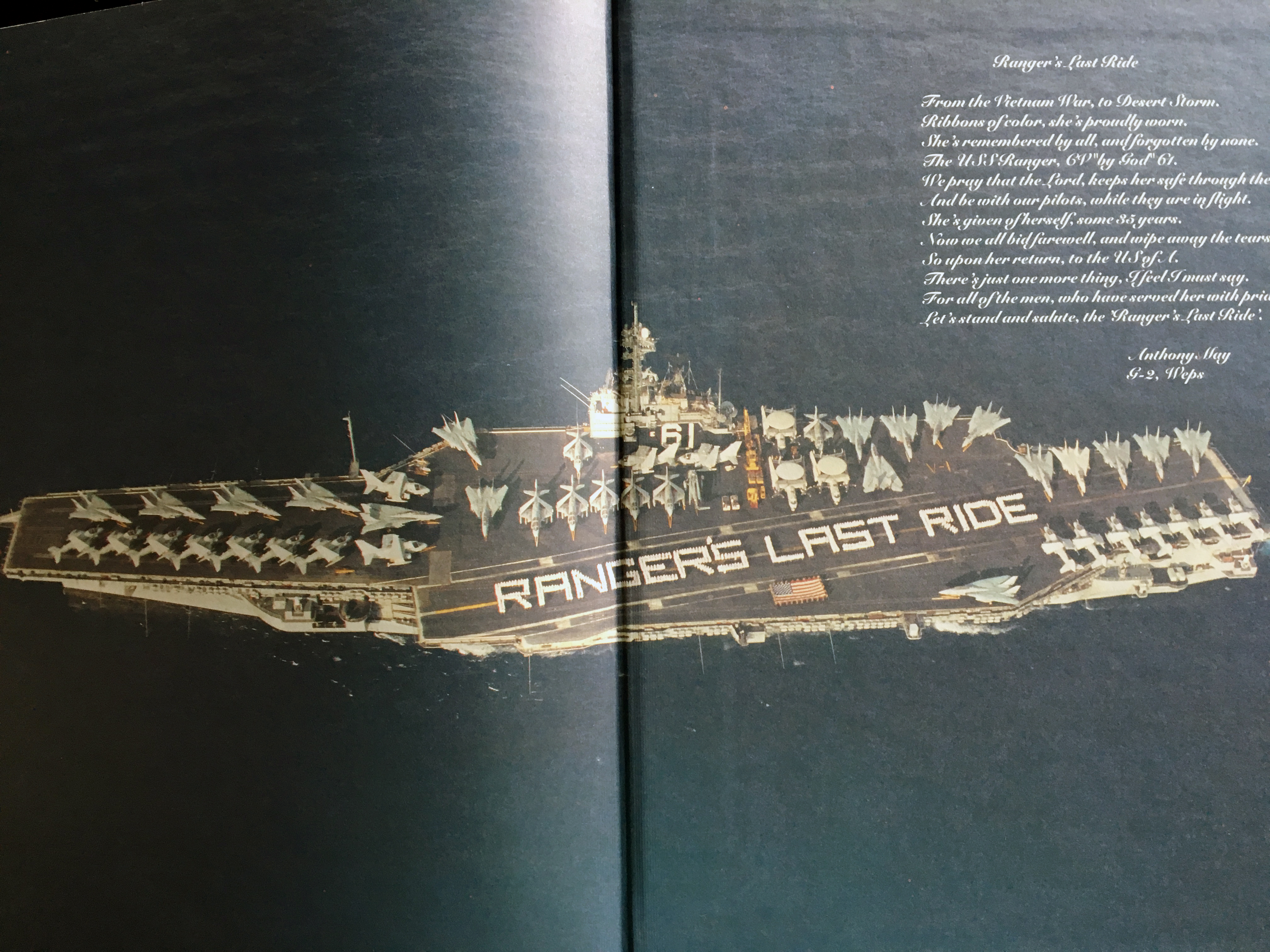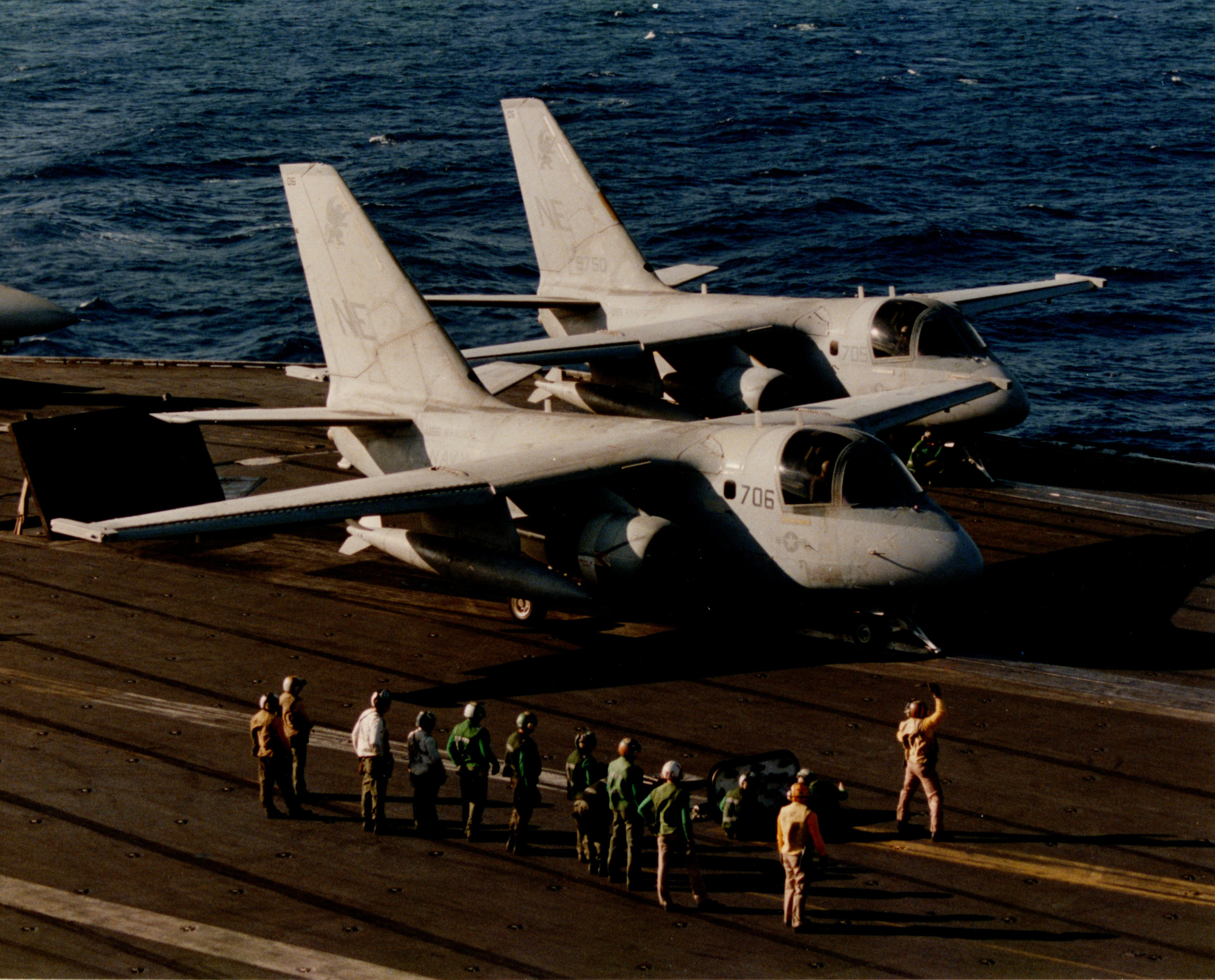
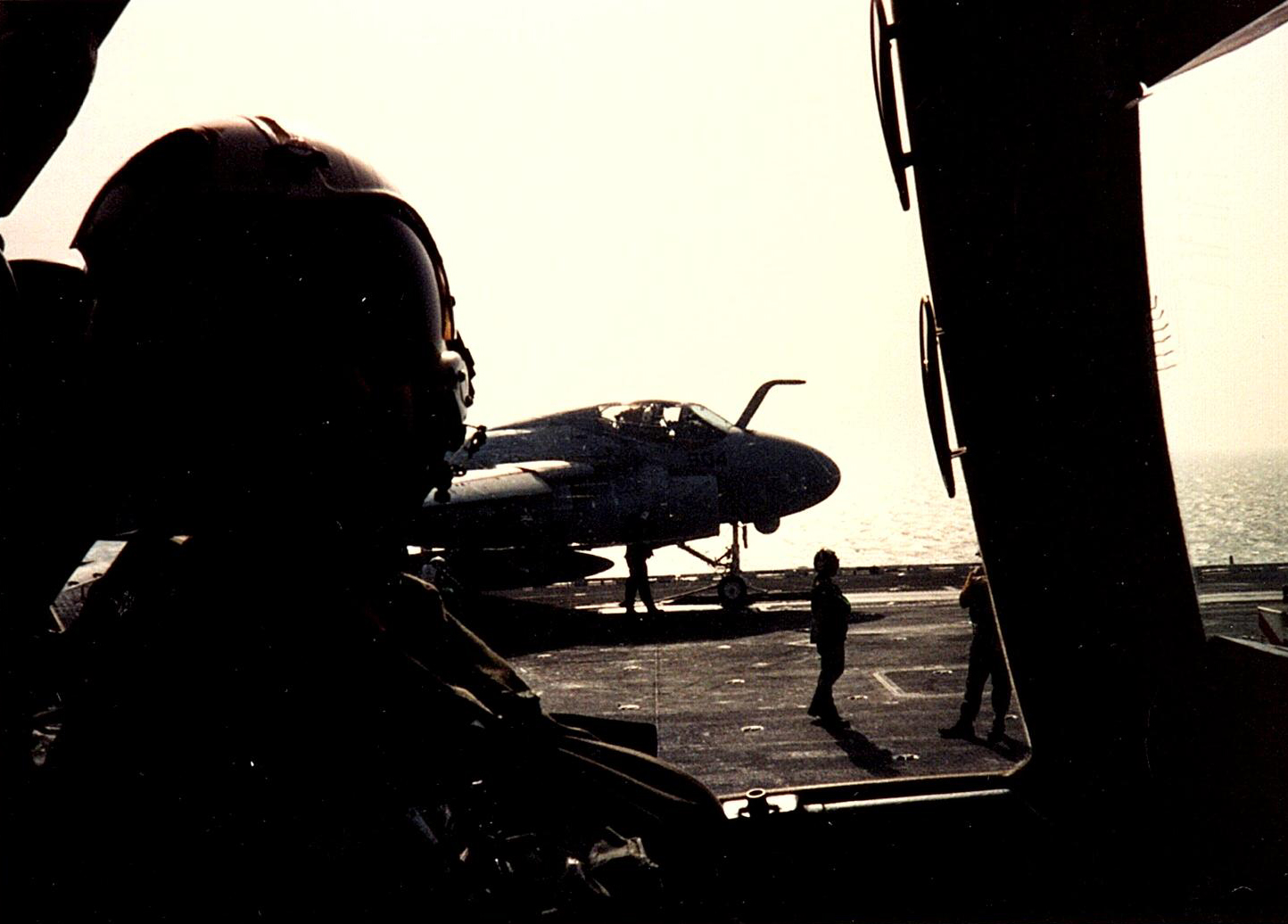

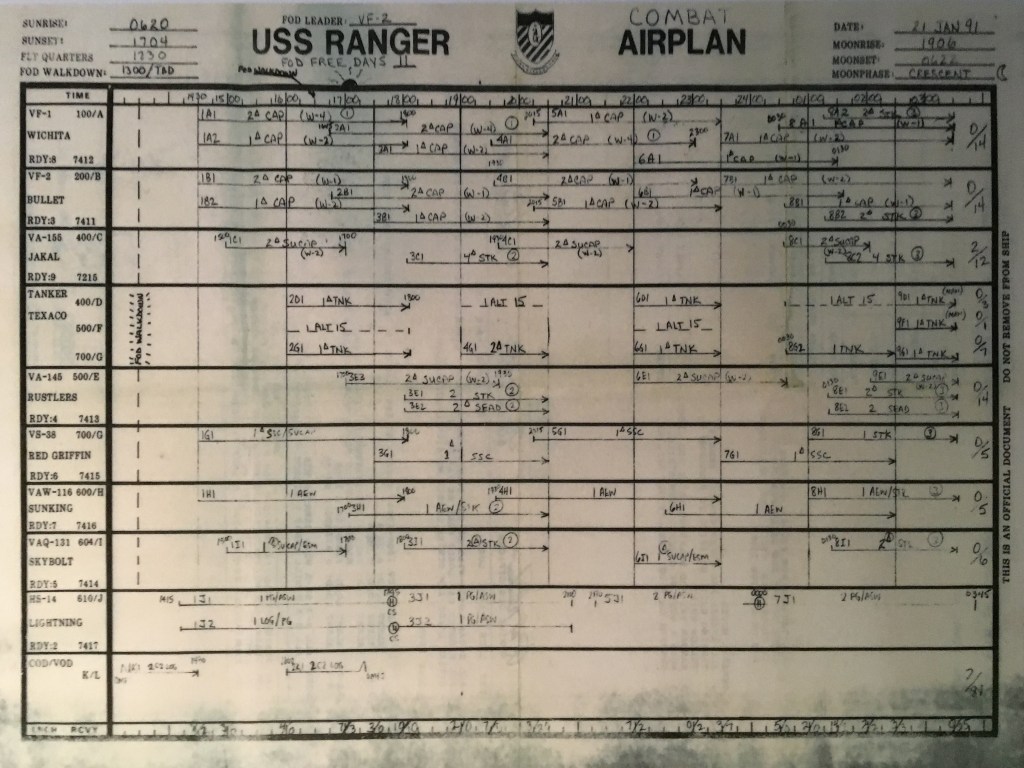
It took about one month to transit from San Diego to the Persian Gulf, and I recall some good times we all had sailing a small boat with friends in the harbor of Subic Bay while the USS Ranger was replenished with armament and supplies in the Philippines. Thanksgiving and Christmas of 1990 were spent onboard ship, and upon entering the Straights of Hormuz I flew patterns over these tight and vulnerable waters with the S-3 Viking’s magnetic anomaly detector (MAD) boom, attempting to locate mines. Once established in theater, we participated in Operation Desert Shield. But by January 17th 1991, the war to force the Iraqis out of Kuwait had begun. I was part of that very first mission of Operation Desert Storm, and I will never forget the heart palpitations I got that evening when a Ranger AirPlan like the one seen here was slid under my stateroom door with my name on the first launch after midnight! For the first time the word “COMBAT” was penned in at the top of the page. What could we expect?
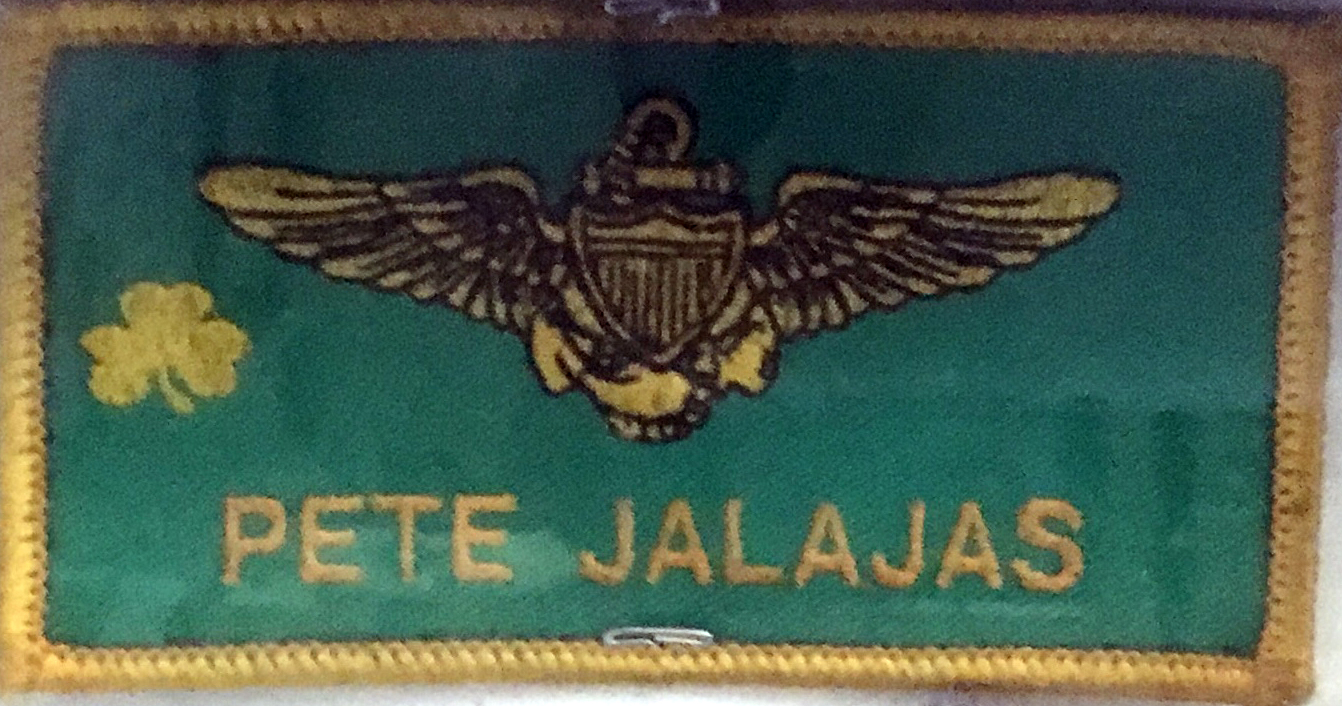
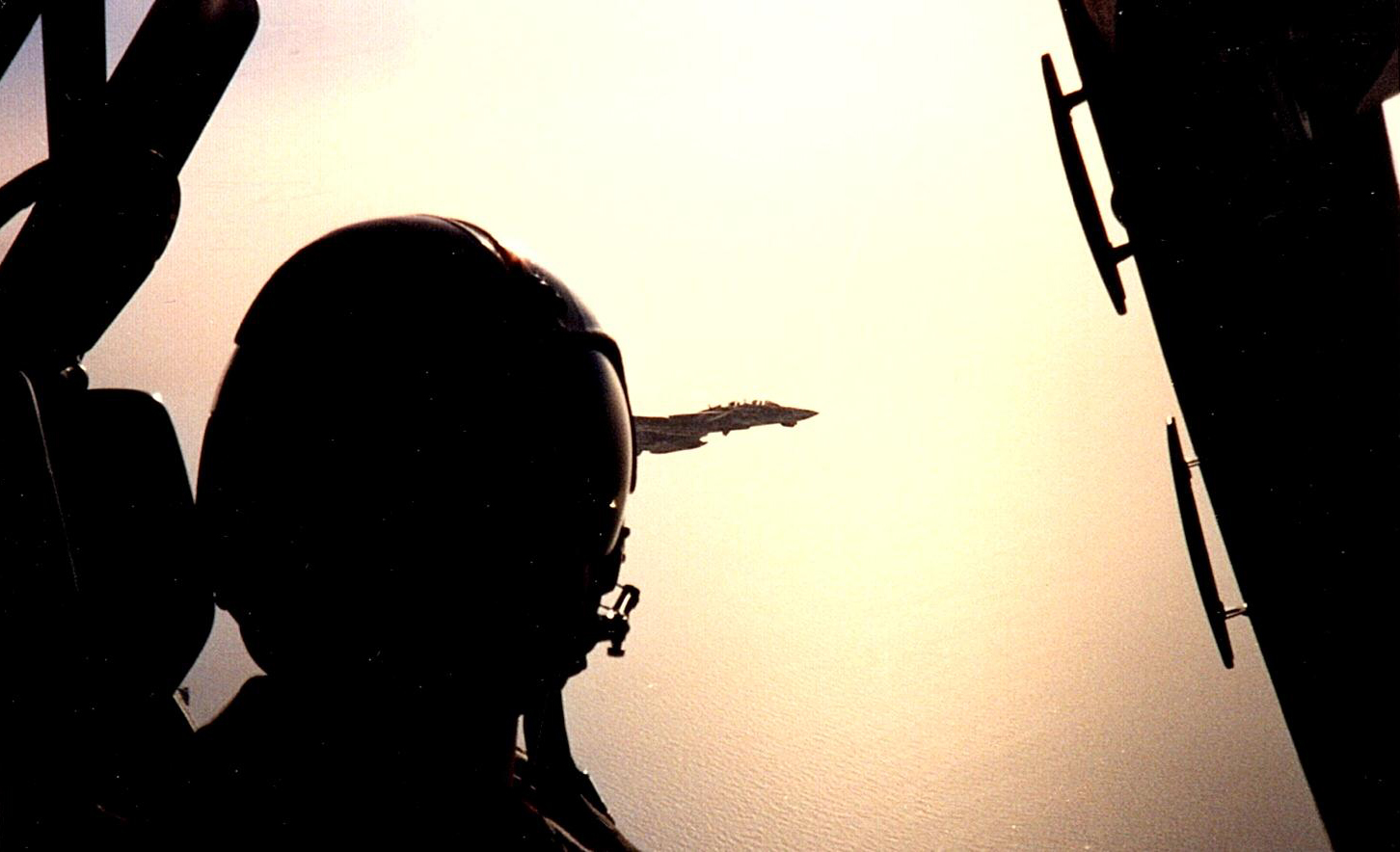

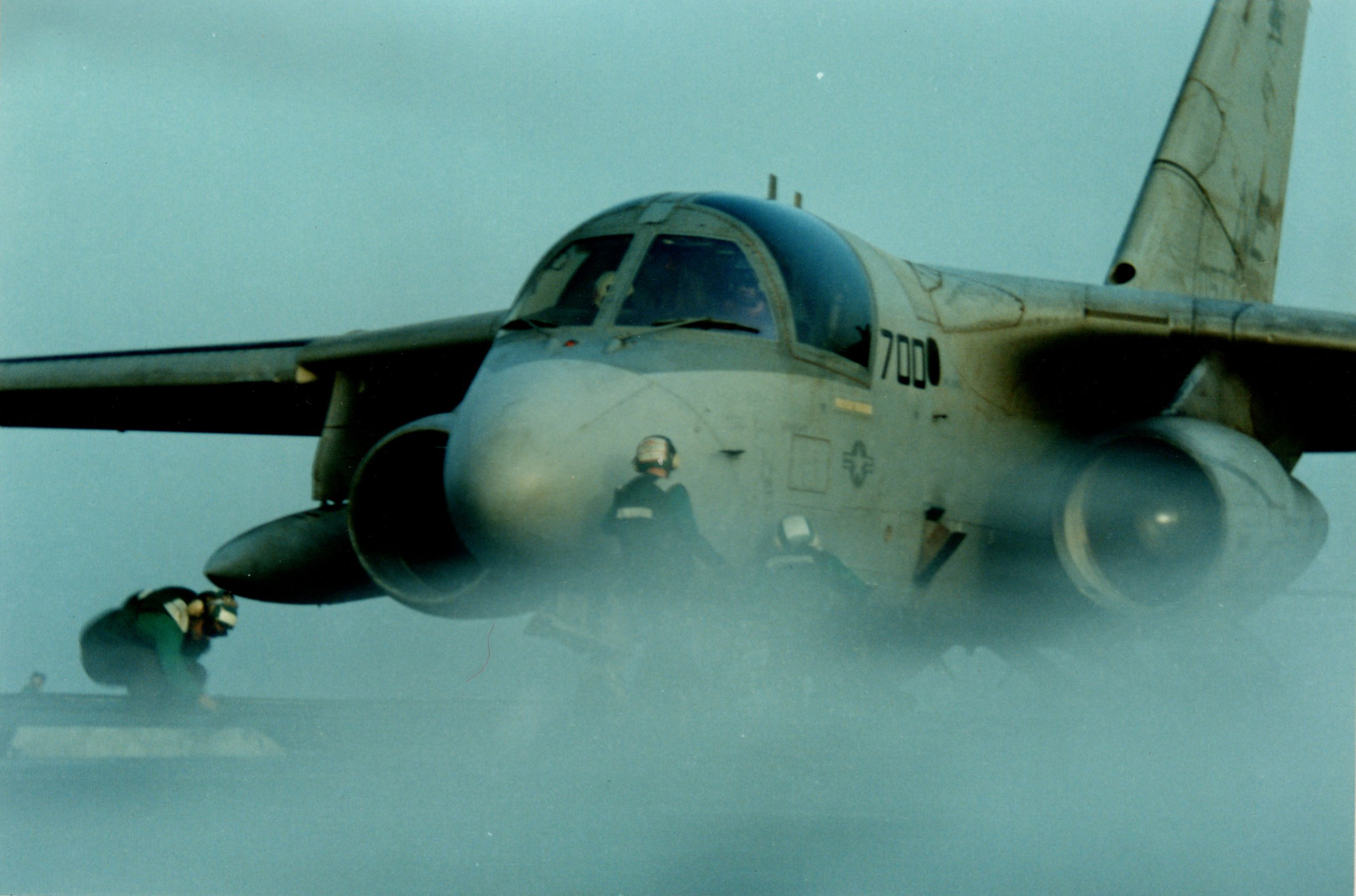


“I am an American and do not speak your language. I will not harm you! I bear no malice towards your people.” This is how the “blood chit,” as it is called, begins. Additionally written in Arabic, Persian, Kurdish , and Turkish, it offers a reward to return a downed aviator in hostile territory back to safety. This folded blood chit was carried by Peter Jalajas during Desert Storm in 1991.




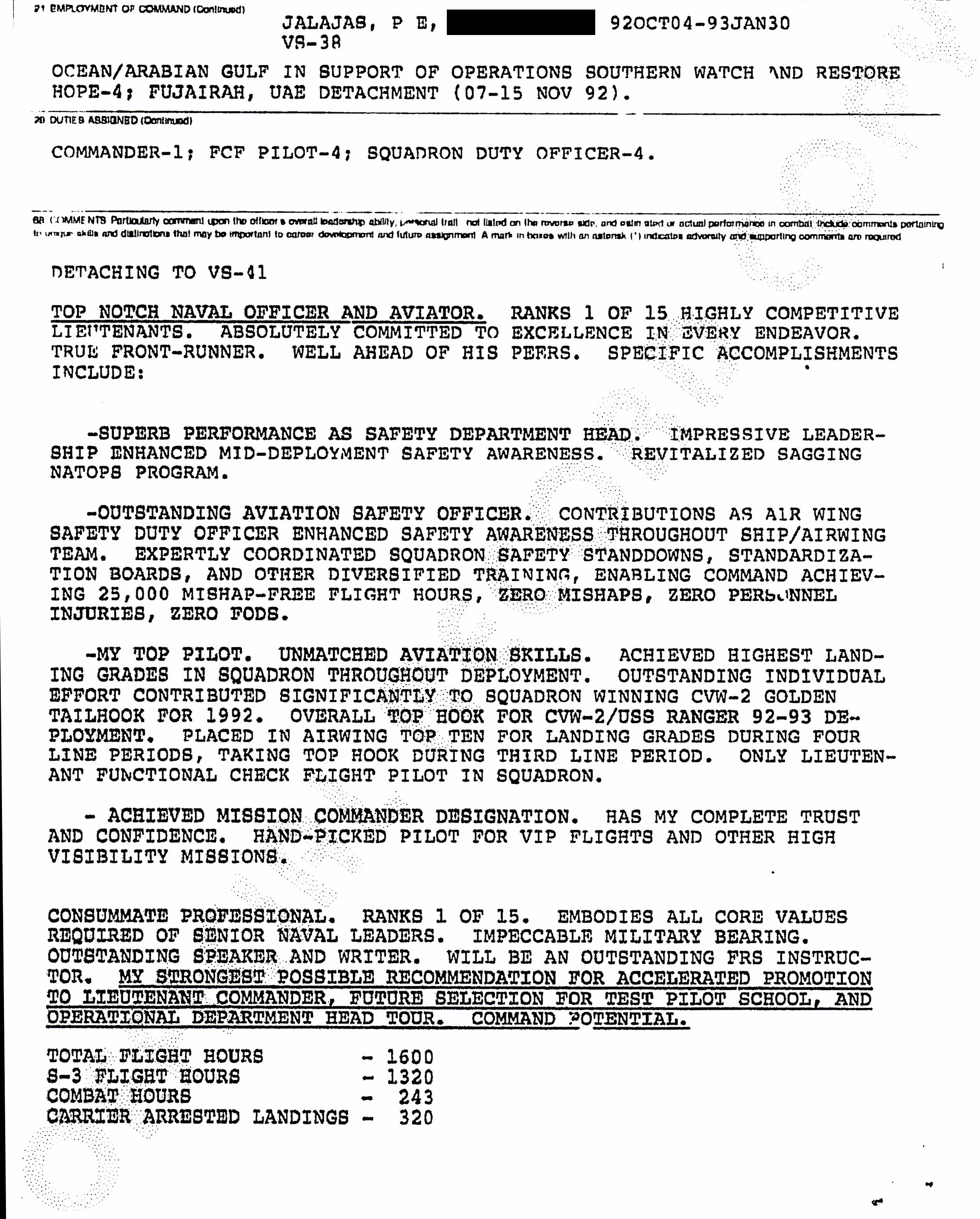
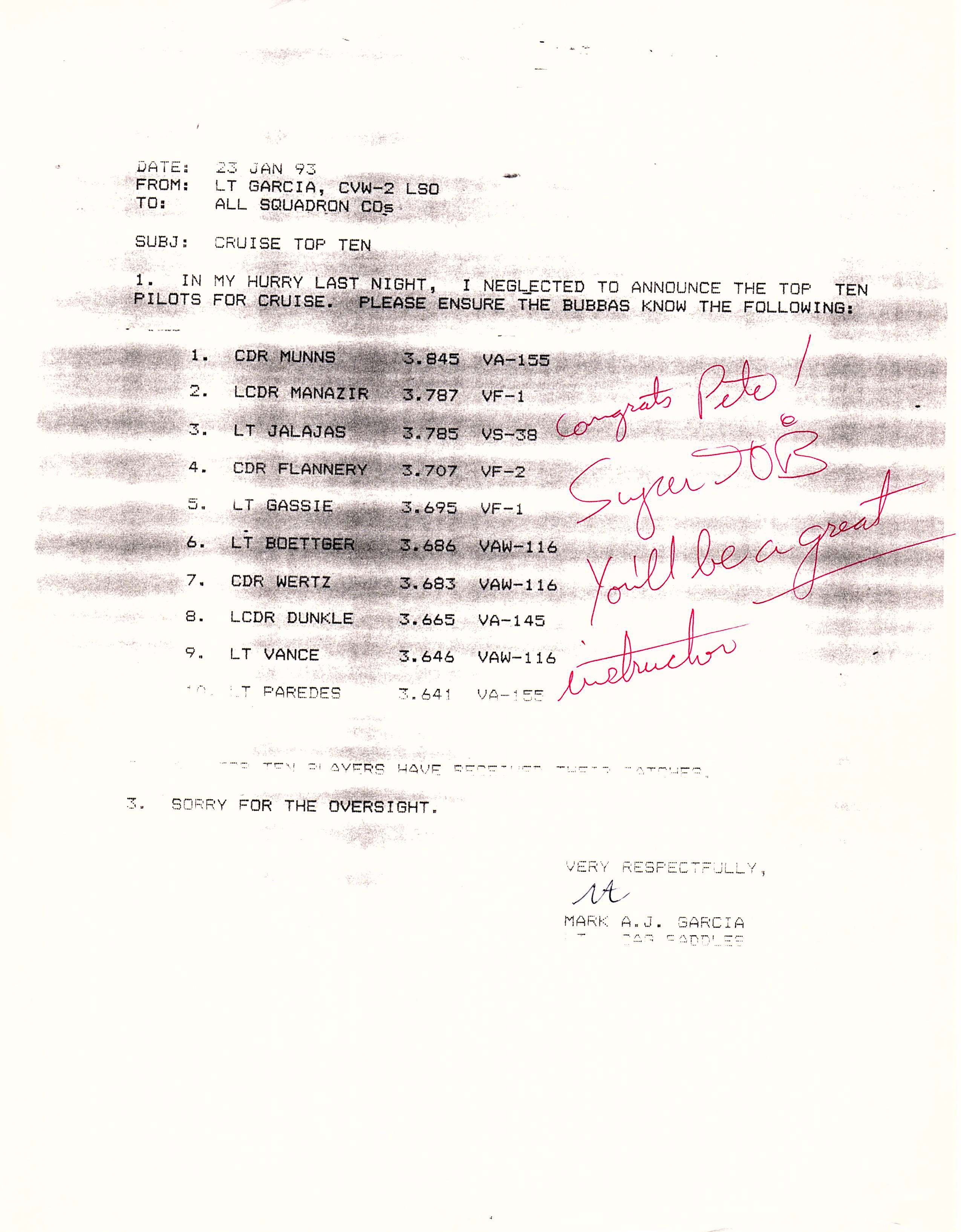
Funny thing, but navy pilots (naval aviators) are highly competitive. Every landing is graded by a team of LSOs – Landing Signal Officers – that for the most part objectively scrutinize every move the pilot makes as he (there were no female pilots yet on my deployments) maneuvers his aircraft to land onboard “the boat.” There are four possible wires to catch with the tailhook, and the three wire is the most desirable. Grading runs from a “NO GRADE” (really bad, like catching a 1 wire), a “Bolter ” (hook skip – try again), a “Wave Off” (really, really bad – try again), a “Fair” (average landing), and an “Okay” (very good landing). I had a good deal of Okay 3 Wires out of my approximately 325 career traps, and those will get you a 4.0 grade, just like getting an “A” on your term paper at school. I did get one perfect pass called an Okay Underlined (worth 5.0!). That was my lucky day. Just letting my peers know, I normally wouldn’t flaunt awards like shown in the photo: two Top Hooks, five Top Tens (out of 100 or so pilots?), and a Top Five Nugget (I was #2 of pilots on their first deployment), but anybody who knows our true enemies in the world knows that they love to defame and destroy the reputation of our best and brightest. That’s how they roll. And so I raise my glass to the truth. Hail Victory!




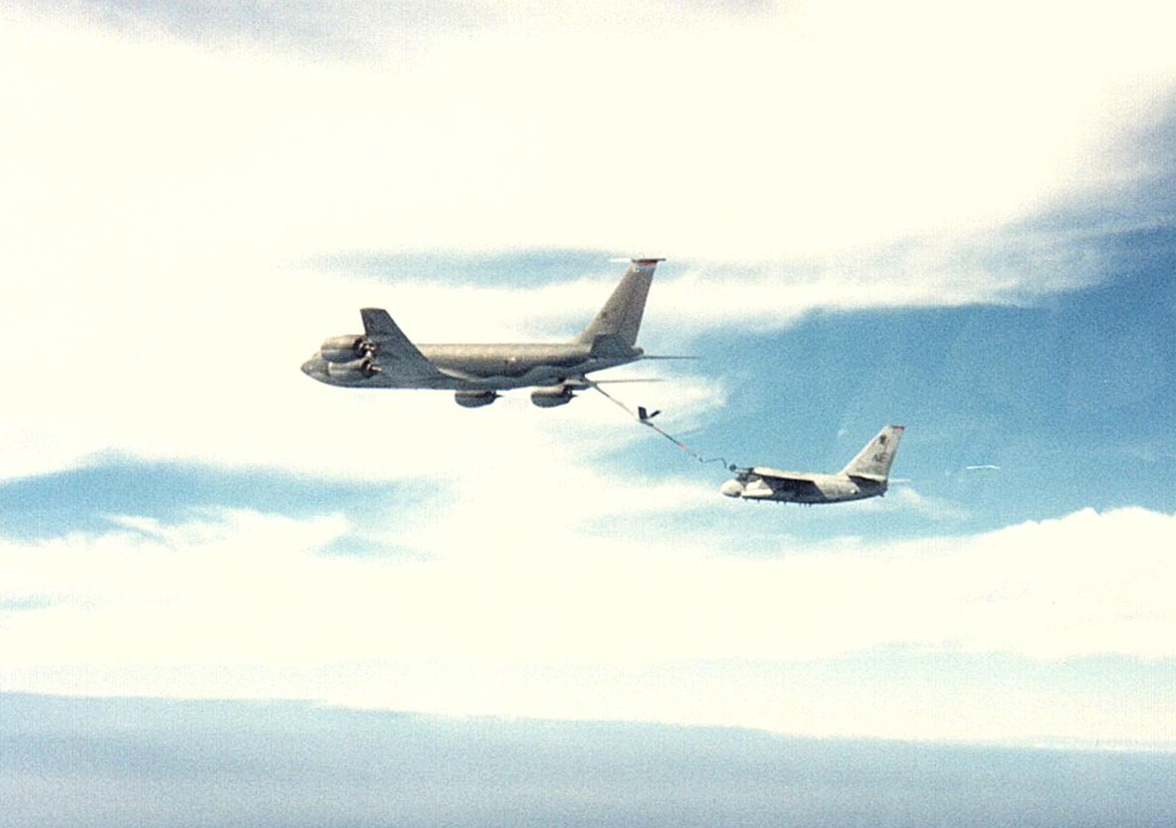
I’ll be honest with you. Tanking off a KC-135 was the most challenging skill I had to perfect as a navy pilot…more difficult than landing on the aircraft carrier. And that mainly was because the basket you see in this picture would be jerking around in the airstream. You should try this at night, like on that first Desert Storm mission of mine! I still have nightmares of doing this! (not really)